
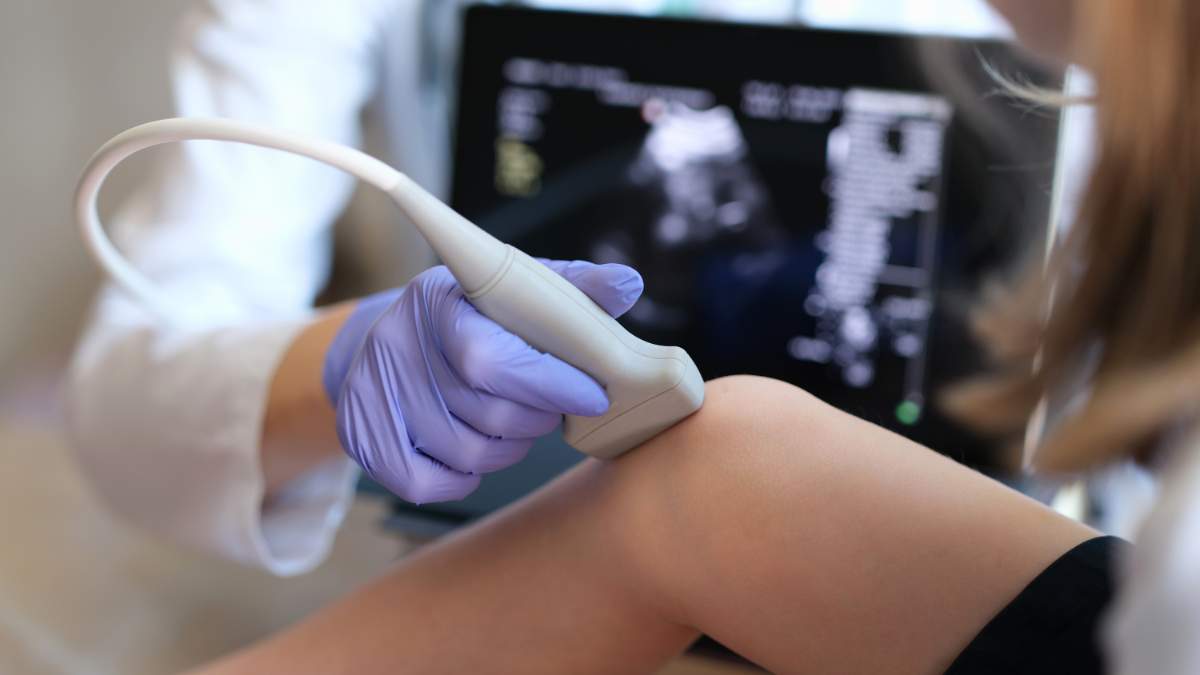
Ultrasound, also known as echography, is a widely used diagnostic method that uses ultrasound waves to image internal tissues and organs. This technique, based on the piezoelectric phenomenon, makes it possible to obtain a real-time cross-sectional image of the examined structure, which makes it extremely useful in many fields of medicine.
Principle of ultrasound
The ultrasound machine consists of a transducer that emits ultrasound waves at frequencies from 2 to 18 MHz and a receiver that records the reflected waves. These waves, as they penetrate tissues, undergo reflection, scattering and absorption. Differences in the acoustic impedance of the tissues determine the degree of reflection of the waves, which makes it possible to generate images of varying echogenicity.
Echogenicity is the ability of a tissue to reflect ultrasound waves. Tissues with high echogenicity (e.g., bones) are displayed as bright, while tissues with low echogenicity (e.g., fluids) are displayed as dark.
Types of ultrasonography
Modern ultrasound offers a wide range of techniques to accurately assess various anatomical structures:
- B-mode ultrasound (Brightness mode): a basic technique that generates two-dimensional grayscale images.
- M-mode (Motion mode) ultrasound: allows observation of movement of structures over time, such as heart valves.
- Doppler ultrasound: based on the Doppler effect, it allows you to assess blood flow in blood vessels. We distinguish:
- Color Doppler: presents the direction and speed of blood flow in colors.
- Spectral Doppler: shows a graphical representation of blood flow velocity over time.
- Power Doppler: detects low-speed blood flow.
- 3D/4D ultrasound: provide a three-dimensional image of the examined structure, in 4D mode also in motion.
- Contrast-enhanced ultrasound: involves the intravenous administration of a contrast agent, which increases the echogenicity of the tissues under examination and improves image quality.
- Elastography: assesses the stiffness of tissues, which has applications, for example, in the diagnosis of liver disease.
Application of ultrasound in medicine
Ultrasonography is used in almost all fields of medicine, including:
1. gastroenterology:
- Evaluation of abdominal organs: liver, gallbladder, pancreas, spleen, kidneys.
- Diagnosis of gastrointestinal diseases: inflammatory bowel disease, gastrointestinal tumors.
- Detection of stones in the gallbladder and kidneys.
2 Cardiology:
- Echocardiography: evaluation of heart structure and function, detection of valvular defects, ischemic heart disease.
- Assessment of blood vessels: carotid arteries, aorta, arteries of the extremities.
3 Endocrinology:
- Evaluation of the thyroid gland: detection of nodules, thyroiditis.
- Parathyroid evaluation: detection of parathyroid adenoma.
4 Gynecology and obstetrics:
- Assessment of a woman’s reproductive organs: uterus, ovaries.
- Pregnancy monitoring: assessment of fetal development, detection of birth defects.
5 Urology:
- Evaluation of kidneys, ureters, bladder, prostate.
- Detection of stones in the urinary tract.
6 Orthopedics:
- Evaluation of joints, tendons, muscles.
- Diagnostics of musculoskeletal injuries.
7 Neurology:
- Brain ultrasound in newborns (transcranial).
- Peripheral nerve evaluation.
8 Oncology:
- Detection and monitoring of cancerous tumors.
- Fine-needle biopsy under ultrasound guidance.
Preparation for the ultrasound examination
Preparation for ultrasound depends on the area to be examined:
- Abdominal ultrasound: 6 hours before the test, be fasting, drink about 1 liter of water one hour before the test and do not urinate.
- Bladder ultrasound: drink about 1 liter of water one hour before the test and do not urinate.
- Gynecological ultrasound: best performed in the first half of the cycle.
- Transrectal (prostate) ultrasound: may require enema.
For other ultrasound examinations, there are usually no special recommendations.
Advantages and limitations of ultrasound
Advantages:
- Safety: no ionizing radiation.
- Non-invasiveness.
- Speed and ease of execution.
- Availability.
- Low cost.
- Ability to perform tests on pregnant women and children.
- Real-time dynamic organ assessment.
Limitations:
- Image quality depends on the experience of the person performing the test.
- Limited penetration of ultrasound waves through bone and gas.
- Difficulties in imaging deep structures.
Summary
Ultrasonography is an extremely valuable diagnostic tool, which, thanks to its advantages, is widely used in medicine. Technological advances in the field of ultrasonography are constantly expanding its capabilities, which translates into ever-increasing diagnostic accuracy and treatment efficiency.


