
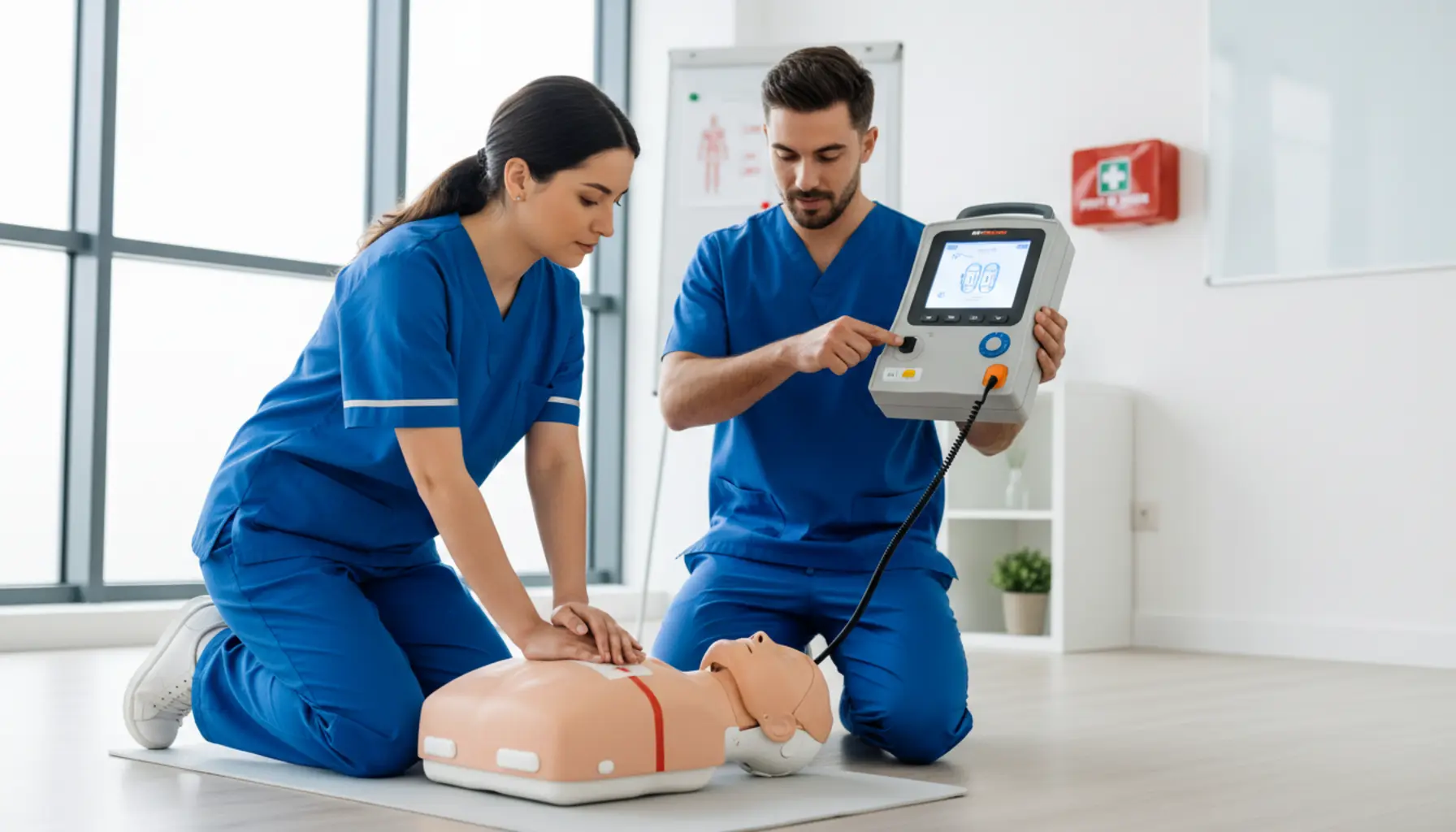
An AED during CPR increases the chances of survival for a person experiencing sudden cardiac arrest. Learn the rules for safely using an AED and the most important steps that will help you effectively provide aid when every minute counts. Proper AED operation allows for the rapid restoration of heart activity and helps prevent permanent brain damage.
Table of Contents
- What is an AED and why is it important
- Step by Step: How to Start Resuscitation
- Using an AED Defibrillator: Instructions
- CPR Algorithm: Key Steps and Principles
- Safety When Using an AED
- AED Rules and Tips
What is an AED and why is it important
An AED (Automated External Defibrillator) is a portable, user-friendly device designed to detect life-threatening heart rhythm disturbances and — if necessary — deliver a controlled electric shock to restore a normal heart rhythm. Unlike classic defibrillators used in hospital departments, the AED is designed so that virtually anyone, even without prior medical experience, can use it. The device automatically analyzes the victim’s ECG recording, recognizes whether there is a shockable rhythm (such as ventricular fibrillation or pulseless ventricular tachycardia), and then gives clear voice and graphic instructions, guiding the rescuer through the entire process step by step. Thus, the AED is a key element of the so-called “chain of survival,” a sequence of actions that maximize the chances of a person with sudden cardiac arrest (SCA) returning to full health. Every minute defibrillation is delayed reduces the chance of survival by as much as 7–10%, so the ability to quickly access an AED in a public space or workplace often makes the real difference between life and death. In many countries, it is already standard practice to place AEDs in public areas, much like fire extinguishers — in shopping malls, train stations, airports, fitness clubs, schools, or office buildings. In Poland, this network is also growing rapidly, and the device itself has become one of the most important first aid tools in sudden cardiac arrest, right next to high-quality chest compressions. Importantly, the AED is a very safe device: it will not deliver energy if the rhythm analysis does not indicate a need for defibrillation, so the risk of accidental shock to the victim or rescuer is extremely low, provided that the basic rules for using the device and the verbal instructions given by the AED are followed. For a layperson, the AED is a kind of “electronic instructor” which, in a stressful situation, takes on the responsibility for medical analysis and the decision to shock, requiring the rescuer only to follow the next steps and ensure the safety of the surroundings.
The importance of the AED arises mainly from the physiology of sudden cardiac arrest and the fact that an ambulance cannot arrive on the scene immediately. In many cases, the cause of SCA is precisely ventricular fibrillation — a chaotic, ineffective rhythm in which the heart quivers instead of pumping blood. The only effective way to end this state is defibrillation, i.e., a brief application of electric energy to “reset” the heart’s activity. Chest compressions alone — though absolutely essential — only partly support circulation and oxygen delivery to the brain, but do not address the underlying rhythm disturbance. Therefore, cardiopulmonary resuscitation (CPR) guidelines strongly emphasize the need to combine high-quality compressions with defibrillation using an AED as quickly as possible. The shorter the time from loss of consciousness to the first shock, the greater the chance that a regular heart rhythm can be restored and that the brain will not suffer irreversible damage from lack of oxygen. The AED also has enormous psychological importance: it reduces the fear of providing assistance because it “leads you by the hand” and suggests exactly what to do — from calling an ambulance, to exposing the chest and attaching the electrodes, to commands like “Do not touch the patient, rhythm analysis in progress.” Such a course of action reduces the risk of error and helps even those facing SCA for the first time to stay calm. Importantly, AED operation is also legally permitted in Poland to persons without medical training, and “Good Samaritan” laws protect those giving first aid, as long as they act reasonably and follow instructions. For the victim’s safety, it is also crucial that the device is constantly monitored for readiness — most AEDs perform self-diagnostics, and an indicator on the housing clearly shows whether the defibrillator is working. All this means that the AED has not only become a medical device, but a real tool for building safety in public spaces, workplaces, and homes, and the skill to use it is now a natural complement to CPR knowledge.
Step by Step: How to Start Resuscitation
Starting cardiopulmonary resuscitation (CPR) with an AED always begins with a quick but safe assessment of the situation. First, make sure the scene is safe for you and others — watch for traffic, electrical hazards, glass, fire, or aggressive behavior. Only when you are sure there is no danger should you approach the victim and try to make contact. Gently shake their shoulders and ask loudly: “Are you okay? Can you hear me?” No reaction or response should be treated as unconsciousness. At this point, calling for help is a priority: shout for help to those around you (“Please call an ambulance and bring the AED!”), and if you are alone, take out your phone, put it on speaker, and dial 112 or 999. The dispatcher will guide your actions, so do not hang up unless necessary — keep the phone with you as you continue the rescue. At the same time, check the person’s breathing: open the airway by tilting the head back and lifting the chin, place your ear near the mouth and nose, and observe the chest for up to 10 seconds. If breathing is abnormal, agonal (occasional gasps), or completely absent, treat the situation as sudden cardiac arrest and begin CPR immediately.
Correctly starting chest compressions is crucial for maintaining blood circulation to the brain and heart until the emergency team arrives or the AED is delivered. Lay the victim on their back on a hard, stable surface, expose the chest if possible (cut or tear away clothing), and kneel beside them at chest height. Place the heel of one hand in the center of the chest on the lower half of the breastbone, the other hand on top, fingers interlaced, keeping your arms straight and shoulders directly above the victim’s breastbone. Compress the chest to a depth of about 5–6 cm in adults, at a rate of 100–120 compressions per minute, allowing the chest to fully recoil after each compression — this lets the heart refill with blood. Keep a rhythm similar to a metronome; if necessary, count compressions in your head or use well-known songs with a similar tempo, but do not slow down or speed up. If you are trained and feel able, after every 30 compressions give 2 rescue breaths, protecting the airway and sealing your mouth over the victim’s (or using a valve mask if available). Each breath should last about 1 second and cause visible chest rise, but not excessive inflation — blowing too hard can cause vomiting and increase the risk of aspiration. If you do not wish or are unable to give breaths, do not stop — give continuous chest compressions; “hands-only” CPR still significantly increases survival chances. Strive for the shortest possible interruptions in compressions: stop only when necessary, such as to connect the AED, switch rescuers, or check breathing after defibrillation, and always follow the device’s instructions. Work with others at the scene — you can assign one person to time-keeping, another to operate the AED, and, if possible, switch compressors every 2 minutes to maintain adequate strength and CPR quality. All these actions prepare the “ground” for safe AED use: high-quality compressions maintain minimal circulation so that defibrillation, when advised by the AED, has a better chance to restore the heart’s effective rhythm.
Using an AED Defibrillator: Instructions
Using an AED defibrillator during CPR is based on a simple, repeatable scheme that minimizes stress and the risk of errors. As soon as the AED arrives at the victim, place it by their head or shoulder on your dominant side for easy access to the device while minimizing interruptions in chest compressions beyond what is absolutely necessary. The first step is always to turn on the device — usually via a large clearly marked ON/OFF button or by opening the case. From this moment, the AED starts issuing loud voice prompts and often visual cues, guiding you through each step. Pay close attention to these and follow them — ideally, one person should continue CPR while another operates the defibrillator. Next, prepare the victim’s chest. The chest should be bare — undo the shirt, cut clothing with the included scissors, or tear fabric as needed. If the skin is wet (e.g., from rain, bathing, heavy sweating), quickly dry it with a towel or clothing, especially where the pads will go. If the victim has a very hairy chest, the AED may have trouble reading the heart rhythm; many kits include disposable razors — if available, quickly shave the pad placement areas, minimizing the pause in compressions. Then remove the electrode pads from the packaging and follow the diagrams on their surfaces — they indicate precise placement: one pad should be placed below the right collarbone, slightly to the side of the sternum, the other under the left armpit, on the side of the chest below the heart. Apply the pads firmly so they do not peel off or lose contact. Watch for jewelry, patches, or medical devices (e.g., pacemaker or cardioverter) — the pads should be placed next to, not directly on, them.
When the pads are in place, the AED will automatically begin heart rhythm analysis or ask you press the “Analyze” button. At this moment, no one must touch the victim, as body movement may disturb the analysis or cause a misreading. Loudly warn bystanders: “Do not touch the victim!” — make sure no one is performing compressions or holding the person’s hands or head. The AED will analyze and then give one of two basic commands: “Shock advised” or “No shock advised / continue CPR”. If the device advises defibrillation, make sure again no one is touching the victim — clearly say “Step back!” and visually check that everyone, including yourself, is away. Then, follow the voice command and press the flashing, clearly marked shock button. In some newer AED models, the shock is delivered automatically; in such cases the device will state that, and your task is only to ensure no one is in contact with the victim. After delivering the shock, the AED will immediately tell you what to do next — nearly always “Start CPR” or “Continue chest compressions”. Chest compressions should resume immediately after the shock without checking the pulse or for signs of life on your own; interruptions should be as brief as possible. Follow the cycle: 30 compressions and 2 breaths (if giving breaths) or continuous compressions, until the AED re-analyzes (usually about every 2 minutes). Every time the device announces “Rhythm analysis”, “Do not touch the patient”, or “Prepare for shock”, immediately stop compressions, step back, and ensure no one else is touching the victim, focusing fully on safety. Remember, the AED is safe for the rescuer and bystanders as long as you do not touch the victim at the moment of shock and do not use the device in extremely high humidity or in direct contact with water (e.g., in a pool or puddle). Never place the pads on visible nitroglycerine patches or directly above an implanted device such as an ICD or pacemaker — move them a few centimeters to the side. For children over 1 year old, use pediatric pads if available (and the pediatric mode on the AED, which lowers the shock energy); in their absence, adult pads may be used according to the manufacturer’s instructions, remembering the recommended placement (often front–back of the torso). Always listen to the AED — it coordinates the analysis and shock cycles. Your main job is to perform strong, rhythmic chest compressions and respond to the commands until EMS arrives or the victim regains normal breathing and clear signs of life.
CPR Algorithm: Key Steps and Principles
The adult CPR algorithm, according to current guidelines, is kept as simple as possible to allow the rescuer to act quickly, confidently, and without unnecessary doubt. The first, essential step is always personal safety — before approaching the victim, look around and check for any hazards (traffic, electricity, fire, toxic fumes). Next, assess the victim’s responsiveness by gently shaking their shoulders and loudly calling, e.g., “Can you hear me?” No response means a life-threatening condition and requires immediate help — ask a specific person to call the emergency number, or, if alone, call yourself, use speakerphone, and follow the dispatcher’s advice. At the same time, if possible, tell another person to fetch the nearest AED. The next step is rapid breathing assessment: open the airway (tilt the head back, lift the chin), observe the chest, listen for, and feel airflow for up to 10 seconds. If breathing is absent or clearly abnormal (e.g., agonal gasps), treat the situation as sudden cardiac arrest. Lay the victim on their back on a hard, stable surface and immediately begin chest compressions. Place the heel of one hand in the center of the chest (on the lower half of the breastbone), place your other hand on top, interlace your fingers, and keep your elbows straight. Compress firmly, to a depth of 5–6 cm, at a rate of 100–120 per minute, allowing for complete chest recoil after each push. Avoid compressions that are too shallow or too slow, as this lowers the efficiency of blood flow. If you are trained and able, after every 30 compressions give 2 rescue breaths — tilt the head, pinch the nostrils, seal the mouth, and breathe in for around 1 second, just enough to cause visible chest rise; let the chest fall between breaths. If you do not wish or cannot perform rescue breaths, continue with “hands-only” CPR at the recommended rate. The key principle of the algorithm is minimizing interruptions — every unnecessary pause reduces blood flow to the heart and brain and thus decreases the chance of successful defibrillation and spontaneous circulation return. While giving compressions, count out loud or use a metronome (including phone apps) to maintain the rate, and if there is more than one rescuer, swap every 2 minutes to prevent fatigue and maintain compression quality. The “30:2” rule remains standard in adults, and constant assessment of response and breathing enables the speedy detection of when the victim is regaining vital functions.

Adding an AED to the CPR algorithm does not change the basic steps, but introduces key elements that significantly improve the chances of survival. The device should be connected as soon as possible, but never at the expense of long interruptions in chest compressions — the rule is: “compress until the AED is ready to analyze”. When the AED is brought over, one person should continue CPR, while the other turns on the device and follows voice and visual instructions. Expose the chest, remove a bra if it hinders pad placement, quickly dry the skin if wet, and shave or bypass areas with heavy hair to ensure good pad-to-skin contact. Attach the pads as shown: one below the right collarbone, the other a few centimeters below the left armpit. For children, use pediatric pads and activate pediatric mode if available; if not, use adult pads placed front and back of the chest so they don’t touch. When the AED instructs not to touch the victim, stop compressions, ensure no one is in contact with the body, and loudly warn others by saying “step back”. Rhythm analysis takes a few seconds; if defibrillation is advised, the device will automatically charge and indicate when to press the shock button (or, in fully automatic models, will deliver the shock itself). Key rule: make sure — visually and verbally — that no one is touching the victim at the moment of shock. Immediately after defibrillation, resume chest compressions without checking the pulse or breathing — continue the 30:2 cycle or “hands-only” compressions for another 2 minutes, after which the AED will re-analyze and direct accordingly. Do not remove the pads from the chest or turn off the AED until EMS takes over or the victim clearly regains consciousness (opens eyes, responds appropriately, breathes normally). Continuity and automaticity are crucial — always repeat the same routine steps: compressions (and, if done, breaths), AED analysis, possible shock, immediate return to compressions. Remember to cooperate: one person can give CPR, another operate the phone and AED, a third manage scene safety or direct rescuers. Using simple, clear commands (“counting to 30”, “breaths now”, “analysis — no one touches”, “after shock back to compressions”) improves organization and maintains high-quality CPR per the recommended algorithm.
Safety When Using an AED
Safety when using an AED is based on a few fundamental rules designed to protect the victim, rescuer, and bystanders. The first, absolutely crucial element is ensuring the scene is safe: before reaching for the defibrillator, check for electrical hazards (broken wires, flooded floor), fire, traffic, violence, or any other danger. AEDs must not be used in explosive environments (e.g., near gas leaks) or when in direct contact with water — if the victim is lying in a puddle or on snow, try to gently move them to a drier, harder surface. Check that the device itself is not damaged, wet, or broken; if you can choose between AEDs, always use the one that appears best maintained and is within the valid battery and pad usage dates. From an electrical safety standpoint, avoid touching metal objects under the victim (ladder, railings, wet dock) during shock, as this can increase stray current risk. You must also properly prepare the chest before applying the pads: dry sweat and water quickly (paper towels or clothing), and if hair is dense, shave the pad areas with the included disposable razor to avoid poor adhesion and arcing. Do not place pads on wet clothing or on metal objects such as chains, earrings, or necklaces — jewelry on the chest should be moved aside or removed without wasting too much time. Correct handling around implanted medical devices (e.g., pacemaker or ICD) is also important: these are usually felt as a hard “box” under the skin below the collarbone; AED pads are applied in standard locations, but not directly over the device, keeping a gap of at least several centimeters to minimize interference and skin burn risk. For medication patches (e.g., on the chest), quickly remove them with gloves and wipe the area so the drug or patch is not unexpectedly heated during shock.
A key aspect of safety is energy management during analysis and shock. Whenever the AED announces it is analyzing, no one should touch the victim, as body movements may interfere with the reading and cause misinterpretation. When a shock is advised, the rescuer should loudly warn those around with commands such as: “Step back!”, “No one touch the victim!”, and visually check that all hands are off and no one is leaning on the victim, their bed, wheelchair, or other connected objects. Only when you are 100% sure no one is in contact with the victim should you press the shock button (semi-automatic models) or allow the AED to shock automatically. Stand securely, preferably on dry ground, and do not lean on surroundings; outdoors (rain, wet pavement, snow) try to find a spot minimizing contact with moisture. Another safety element is using the correct pads: use standard pads for adults and older children, pediatric pads and mode for small children to reduce shock energy; if only adult pads are available, follow local guidelines (usually front–back placement), making sure the pads do not touch and are applied to dry skin. Never place pads on damaged, severely burned, or macerated skin — in such cases, place them as close as possible to the standard points, maintaining relative orientation. From a legal and psychological perspective, remember in Poland a layperson providing aid acts under the “Good Samaritan” rule, and the AED is designed not to shock if there is no indication for defibrillation, practically removing the risk of “misuse” of the device medically. Even if you feel nervous or stressed, listening to and following the AED’s step-by-step prompts limits errors — the AED will remind you to step back before shock, resume compressions, and keep working until emergency services arrive. Whenever available, use gloves or rescue masks to reduce the risk of contact with blood and body fluids — not a requirement to start CPR or AED use, but it does increase rescuer safety. Ultimately, safety is a matter of common sense, adhering to device instructions, and consistently applying simple rules: dry environment, no contact during shocks, correct pad application, surroundings control, and knowing you are acting within the law and up-to-date resuscitation guidelines.
AED Rules and Tips
Safe and effective AED use is based on a few universal principles, regardless of device model or incident location. First, always start with a safety assessment — a defibrillator does not replace common sense. Do not approach the victim if the area is dangerous (busy road, fire, electric shock risk, smoke, aggressive people) until services have secured the scene. Once it is safe, perform a standard victim assessment: check response, breathing, call for help, and ask a specific person to bring the AED (“You in the blue jacket, please bring the defibrillator and call the ambulance”). The second pillar is to turn on the AED as soon as possible — the device will guide you step by step, so the sooner you start it, the less you will hesitate and the more you will do in practice. Do not wait until after several CPR cycles; activate the AED as soon as it arrives. Once it is on, strictly follow the voice instructions, and, if present, on-screen prompts — all commands are designed so a layperson can manage under stress. Be aware the AED is “intelligent” — it analyzes the heart rhythm and will not allow a shock if not indicated, significantly reducing risk of harm. Remember also that AEDs do not replace the basic rule: interruptions in chest compressions should be as short as possible. Keep compressions going until the device clearly instructs to pause for rhythm analysis; after a shock, or if “no shock advised”, resume CPR immediately, without waiting for return of signs of life. In practical terms, it is best for tasks to be split between at least two people: one continues compressions, the other prepares the AED, exposes the chest, attaches the pads, and manages the shock. If you are alone, do not skip the AED — just proceed sequentially: briefly pause compressions to attach the pads and start analysis, then return to CPR.
When attaching pads, always follow the diagrams on the packaging and pads themselves. Standard placement for adults is one pad below the right collarbone, slightly to the right of the sternum, the other on the left side, below the armpit, about at the ribcage’s lower level — this allows current to flow through the most important heart regions. Skin should be exposed, dry, and hair removed if needed in the pad areas — if an AED kit has a disposable razor, quickly shave a small area, but do not interrupt CPR for more than a few seconds. Remove jewelry touching potential pad placement (necklaces, metal chains) and any patches or cosmetics that may affect adhesion. For implanted devices such as pacemakers or ICDs, recognize them by a small, hard bump under the collarbone — do not place pads directly over the implant; move them a few centimeters to the side so the current does not pass through the device. Children require special attention — if you have pediatric pads, use them as per the manufacturer’s instructions (often one pad on the front chest, the other on the back between the shoulder blades) and activate pediatric mode if available. If you only have adult pads, guidelines permit their use for children over 1 year old, just ensure the pads do not touch. Watch your surroundings: do not perform defibrillation if the person is lying in water or on very wet ground — move them to a dry surface and dry the chest. When analyzing rhythm and during shock, strongly and loudly command “Do not touch the victim!”, visually check no one is touching the body or bed, and only then press the shock button if prompted by the AED. Remember, in Poland the “Good Samaritan” rule applies: a person providing help in good faith and following device instructions is legally protected, provided they do not act with extreme irresponsibility. Do not be afraid to touch the AED or make minor mistakes — the greatest danger is inaction. Familiarizing yourself with the AED locations at your work, gym, or shopping center, and taking part in short CPR/AED trainings, will help you act more quickly, confidently, and with a better chance to save a life in a real situation.
Summary
In summary, an AED is a device that can save lives if used properly during cardiopulmonary resuscitation (CPR). It is important to know what the process of using it looks like, from preparation, to use on an unconscious person, to restarting chest compressions. Remember to always be on a dry surface and remove all metal objects from the person in need. Knowing the CPR algorithm allows you to efficiently carry out the entire process and potentially save a life.