
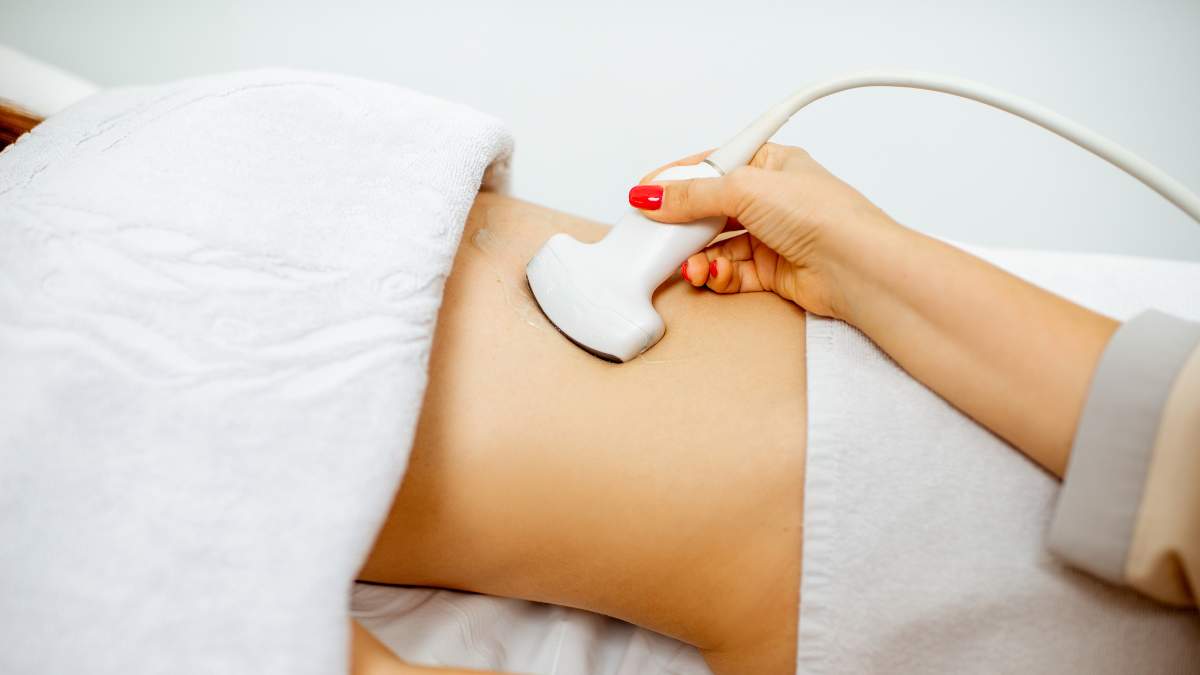
Gynaecological ultrasound
The first visit to the gynecologist, the first tests, the first questions about intimate health – these are natural stages in the life of every young woman. One of the fundamental, and at the same time often the most questionable tests, is gynecological ultrasound. Does it hurt? How to prepare for it? What to expect? What does the doctor actually see in this “black and white picture” during a gynaecological ultrasound?
Table of contents
What is gynaecological ultrasound? Basics for every woman
Let’s start with the basics. Gynaecological ultrasound (ultrasonography) is a safe, non-invasive and painless imaging test that can be performed in Warsaw. Its operation is based on the use of ultrasound waves, which are inaudible and harmless to the human ear and body.
A special head of the ultrasound machine sends waves towards the pelvic organs (uterus, ovaries, fallopian tubes). These waves bounce off the tissues, return to the head, and then the computer converts them into an image visible in real time on the monitor. This allows the doctor to accurately assess the structure, size, shape and condition of your reproductive organs during an ultrasound examination. It’s a bit like “looking inside” without using a scalpel.
The most important advantages of gynecological ultrasound:
- Safety: The test does not use X-rays (X-rays), so it is completely safe and can be repeated many times, even in pregnant women.
- Availability: It is one of the most frequently performed tests in gynecology, especially in the context of pregnancy ultrasound.
- Accuracy: It allows you to detect many abnormalities at a very early stage.
- Real-time Result: The doctor sees the image immediately thanks to the ultrasound probe and can interpret and discuss it with the patient on an ongoing basis.
Types of gynaecological ultrasound: vaginal vs. transabdominal
Gynaecological ultrasound can be performed in two main ways. The choice of method depends on the purpose of the test, the patient’s age and whether she has started intercourse.
H3: Transvaginal ultrasound – standard in gynaecology
This is the most frequently performed and most accurate type of gynecological ultrasound in sexually active women.
- What does the test look like? The doctor puts a disposable cover (similar to a condom) and gel on a special, oblong head of the apparatus (about 1.5-2 cm in diameter), and then gently inserts it into the vagina.
- Why is it so accurate? The transducer is located very close to the examined organs – the uterus and ovaries. This allows for an extremely precise and detailed image, impossible to achieve with any other method.
- Does it hurt? For the vast majority of women, the examination is painless. You may feel a slight pressure or a feeling of “expansion”, but it should not be pain. The key is to relax your muscles.
H3: Ultrasound through the abdominal wall (transabdominal)
This method is mainly used in girls and young women who have not yet started intercourse (virgins), as well as in some cases during pregnancy or to assess large lesions, e.g. extensive cysts.
- What does the test look like? The position is similar to that of an abdominal ultrasound. You lie on your back and the doctor lubricates the lower part of your abdomen with the gel and moves the head over it.
- Why is a full bladder needed? A fluid-filled bladder acts as an ‘acoustic window’ – it pushes out intestinal loops that could obscure the image and makes it easier for ultrasound waves to reach the uterus and ovaries.
- Restrictions on access to medical tests can make diagnosis difficult. The image obtained by this method is less detailed than in the case of vaginal ultrasound, because the waves have to travel a longer way through the skin, fat tissue and muscles.
When should a gynaecological ultrasound be performed? The most common indications

An ultrasound is not a test performed “just in case” during every visit. A doctor orders them when there are specific diagnostic or preventive reasons. Here are the most common ones:
- Menstrual disorders: Irregular cycles, very heavy or scanty bleeding, intermenstrual bleeding.
- Pain in the lower abdomen: Acute or chronic pain in the pelvic area that is not related to menstruation.
- Painful menstruation may be an indication for a gynecological ultrasound. If the pain is severe enough to make it difficult to function normally.
- Infertility diagnostics: Assessment of uterine structure, fallopian tube patency (in a special sono-HSG test) and monitoring of ovulation (ovarian follicles).
- Suspected defects in the structure of the reproductive organ.
- Suspicion or monitoring of changes:
- Cysts on the ovaries: Many of them are harmless functional changes, but require observation, m.in example, in the context of an ultrasound of the reproductive organ.
- Uterine fibroids: it is important to have regular ultrasound examinations. Benign tumors that can cause bleeding or pain.
- Endometrial polyps: Small changes in the lining of the uterus.
- Diagnosis of polycystic ovary syndrome (PCOS) often requires a gynecological ultrasound.
- Suspected endometriosis.
- Confirmation of early pregnancy and assessment of its correct location (exclusion of ectopic pregnancy).
- Checking the position of the IUD (coil).
- Preventive examination: Often as part of the annual gynecological check-up.
How to prepare for a gynaecological ultrasound? Practical guide
Preparation is simple, but crucial for the quality of the test. It varies depending on the method you choose.
Preparation for vaginal (transvaginal) ultrasound
- Date of the test: It is best to make an appointment in the first phase of the cycle, just after the end of menstruation (usually between the 5th and 10th day of the cycle). This is when the endometrium (uterine lining) is at its thinnest, which makes it easier to assess. If the test is to monitor ovulation, your doctor will schedule a different date.
- Empty the bladder: This is the most important rule! Use the toilet before entering the office. A full bladder in this type of examination interferes and obscures the image.
- Hygiene: Standard, daily intimate hygiene is enough.
- Take the result of the previous test: If you have already had an ultrasound done, take the description with you. This is a valuable comparison for a doctor.
Preparation for ultrasound through the abdominal wall
- Fill the bladder: This is an absolute must! About 1-1.5 hours before the test, start drinking still water (about 1-1.5 liters).
- Do not urinate: You must come to the examination with a feeling of strong pressure on the bladder. It may be uncomfortable, but it is essential.
- Diet: It is worth consulting a doctor during a gynaecological ultrasound to ensure well-being. On the day of the test, avoid bloating foods and carbonated drinks.
The course of a visit with a gynaecological ultrasound – step by step
Stress often results from ignorance, so it is worth checking what tests are available. Let’s see what the examination usually looks like to make you feel more confident.
- Anamnesis: your doctor will make sure to understand your symptoms related to your intimate areas. The doctor will ask about the date of your last menstrual period, the regularity of your cycles, the reason for the visit and any discomfort.
- Preparation: You will be asked to strip from the waist down and go to the toilet (for a transvaginal ultrasound), which is standard procedure. You should have intimacy in the office (a screen, a separate room).
- Position: You will lie down in the gynaecological chair (for vaginal ultrasound) or on a couch (for transabdominal ultrasound).
- Gynaecological ultrasound examination is crucial in the diagnosis of many diseases. Your doctor will apply the gel to your head or to your abdomen. The gel is water-based, does not stain and is essential for proper wave conduction. He will then begin the examination by observing the image on the monitor.
- Communication: A good doctor will tell you what he sees on an ongoing basis. Feel free to ask questions! If something is bothering you, tell us about it.
- Duration: The examination itself usually takes 5 to 15 minutes.
- Conclusion: After the test, you will be given lignin to wipe off the gel. You can get dressed.
- Result: The doctor will discuss the result with you, explain what he or she has observed and make recommendations. You will also receive a written description of the examination along with photos (printouts).
Does gynaecological ultrasound hurt? We dispel doubts
This is one of the most common worries of young women, who often seek medical help. The answer is: a properly performed gynaecological ultrasound should not hurt. With a transvaginal ultrasound, you may feel pressure, but not sharp pain. However, if you experience pain, tell your doctor immediately. This may be a signal of inflammation or other ailment, and for the doctor it is important diagnostic information.
What can be seen on a gynaecological ultrasound? Interpretation and diagnostics
For the patient, the image on the monitor is a tangle of gray and black. For an experienced doctor, it is a map of your intimate health. What does the specialist evaluate?
- Uterus: Its position (anterior or posterior flexion), size, shape. Your doctor assesses the thickness and homogeneity of the uterine muscle (myometrium) for fibroids. The assessment of the endometrium – the mucous membrane lining the uterine cavity – is crucial. Its thickness varies depending on the day of the cycle and is an important hormonal indicator.
- Ovaries: Their size, structure and the presence of ovarian follicles. In young women, the sight of numerous, small follicles is the norm. The doctor looks for abnormal lesions, such as simple cysts, endometrial cysts or solid tumors, during an ultrasound examination. The characteristic image of the ovaries may suggest PCOS.
- Fallopian tubes: Normal fallopian tubes are usually invisible on ultrasound. They become visible when they are filled with fluid (fallopian tube hydrocele), which can indicate inflammation or obstruction.
- Douglas Bay: This is the space behind the uterus. The doctor checks for fluid buildup, which may indicate ovulation, inflammation, or rupture of the cyst.
Gynaecological ultrasound as the key to taking care of intimate health
Gynaecological ultrasound is a powerful and patient-friendly tool that allows for early detection of many diseases and effective health monitoring. For a young woman, it is the foundation of prevention and conscious self-care. Remember that regular visits to the gynaecologist and performing the recommended tests are not a reason to be ashamed or afraid, but an expression of maturity and care for your own body, as well as taking care of your health under the National Health Fund. Your health is in your hands, and modern medicine gives you the tools to take care of it in the best possible way.


